
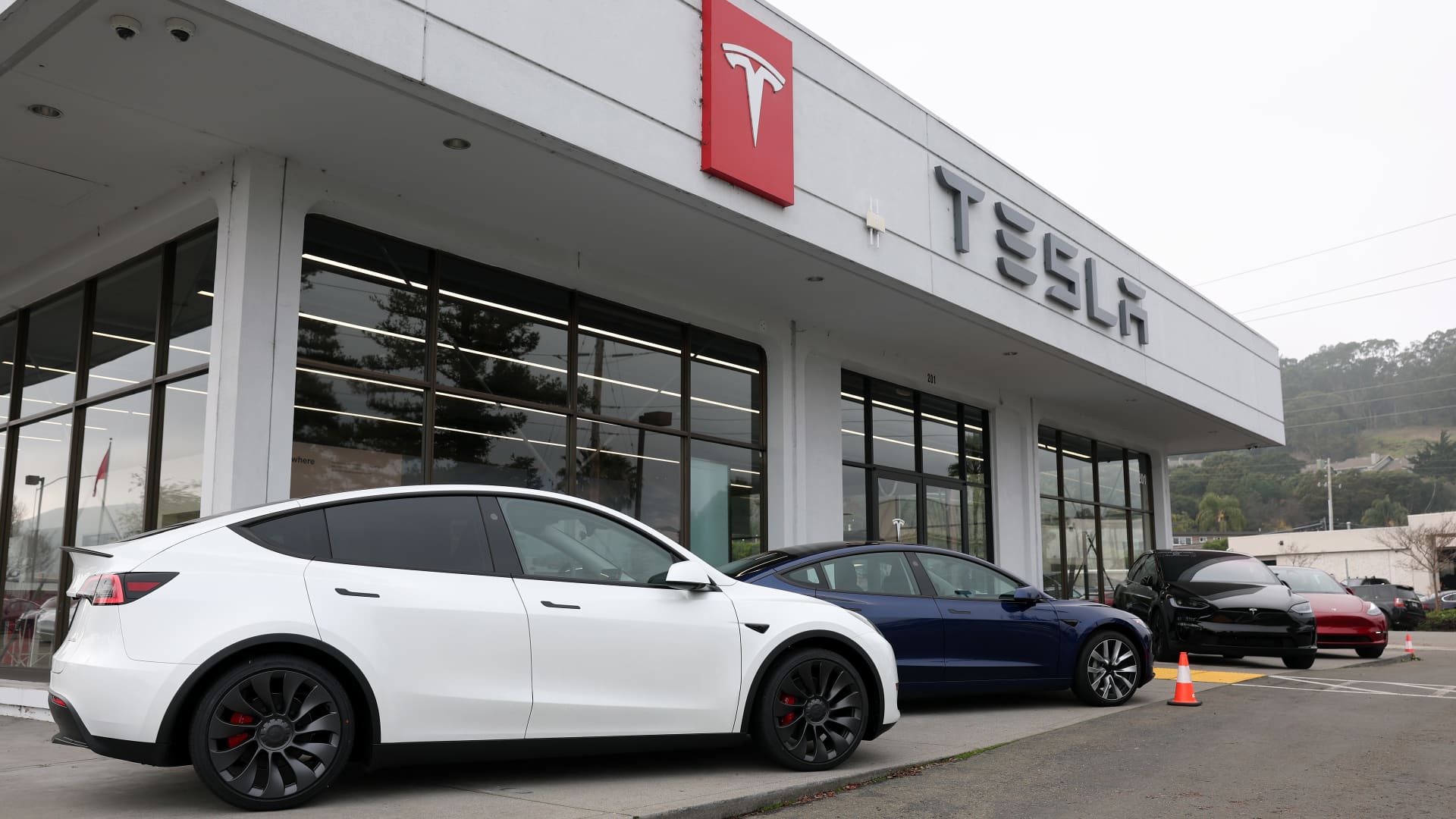

Tesla models Y and 3 are displayed at a Tesla showroom in Corte Madera, California, on Dec. 20, 2024.
Justin Sullivan | Getty Images
Tesla (TSLA) is under increasing scrutiny as U.S. federal auto safety regulators demand records related to an ongoing investigation into potential safety defects in the company’s flush-mounted, retractable door handles. The core concern: these handles may trap occupants inside the vehicle, particularly in emergency situations.
The National Highway Traffic Safety Administration (NHTSA) has intensified its investigation, initiated in September, after receiving a continuous stream of complaints from Tesla owners. In a formal letter, the agency has directed Tesla to furnish comprehensive documentation addressing the reported issues.
According to NHTSA filings, complaints center around the inability to enter or exit Tesla vehicles due to malfunctions stemming from battery power loss and other system failures affecting the door handle operation. The most alarming reports detail scenarios where children were trapped inside overheated vehicles, necessitating intervention from first responders or, in extreme cases, requiring windows to be broken for access.
The Office of Defects Investigations at NHTSA stated that, as of October 27, 2025, they had “received 16 reports of exterior door handles becoming inoperative due to low 12VDC battery voltage in certain MY 2021 Tesla Model Y vehicles.” This data point underscores the focus of the investigation on the Model Y, although the scope extends to other models as well.
The genesis of NHTSA’s investigation can be traced back to media reports highlighting incidents of injury and even fatalities stemming from occupants being trapped in Tesla vehicles following collisions or battery failures. These events illuminated a potential design flaw with serious safety implications.
While Tesla’s design lead, Franz Von Holzhausen, has hinted at potential design modifications to address these concerns, the broader industry is taking note. The inherent complexity of electronic door handles presents engineering challenges including ensuring reliable operation in a variety of environmental conditions and addressing potential failure modes. Redundancy and fail-safe mechanisms are crucial to prevent entrapment hazards.
The move towards simpler, more mechanically reliable door handle designs reflects a growing awareness of these potential pitfalls. Volkswagen CEO Thomas Schäfer’s recent comments that his company’s customers have no desire for flush-mounted door handles and that VW has no plans to implement them, illustrate the industry’s shifting perception of this technology.
Furthermore, upcoming vehicle safety regulations in China are setting a new standard for door handle design, demanding clearly marked, accessible, and user-friendly emergency release mechanisms within vehicle interiors. This forward-thinking approach to safety emphasizes the need for robust fail-safe systems.
NHTSA’s probe is focused on records pertaining to all “2021 Tesla Model Y vehicles manufactured for sale or lease in the United States.” The investigation also encompasses “peer vehicles,” notably Tesla Model 3 and Model Y vehicles from model years 2017 to 2022, as well as related systems like door handles, latches, 12VDC batteries, and crucial software components.
Tesla faces a deadline of December 10 to provide the requested records. The stakes are high; failure to comply fully and promptly could result in significant penalties, potentially reaching “$27,874 per violation per day, with a maximum of $139,356,994.” This underscores the gravity of the investigation and the importance of Tesla’s adherence to regulatory demands.
Original article, Author: Tobias. If you wish to reprint this article, please indicate the source:https://aicnbc.com/12183.html
