
“`html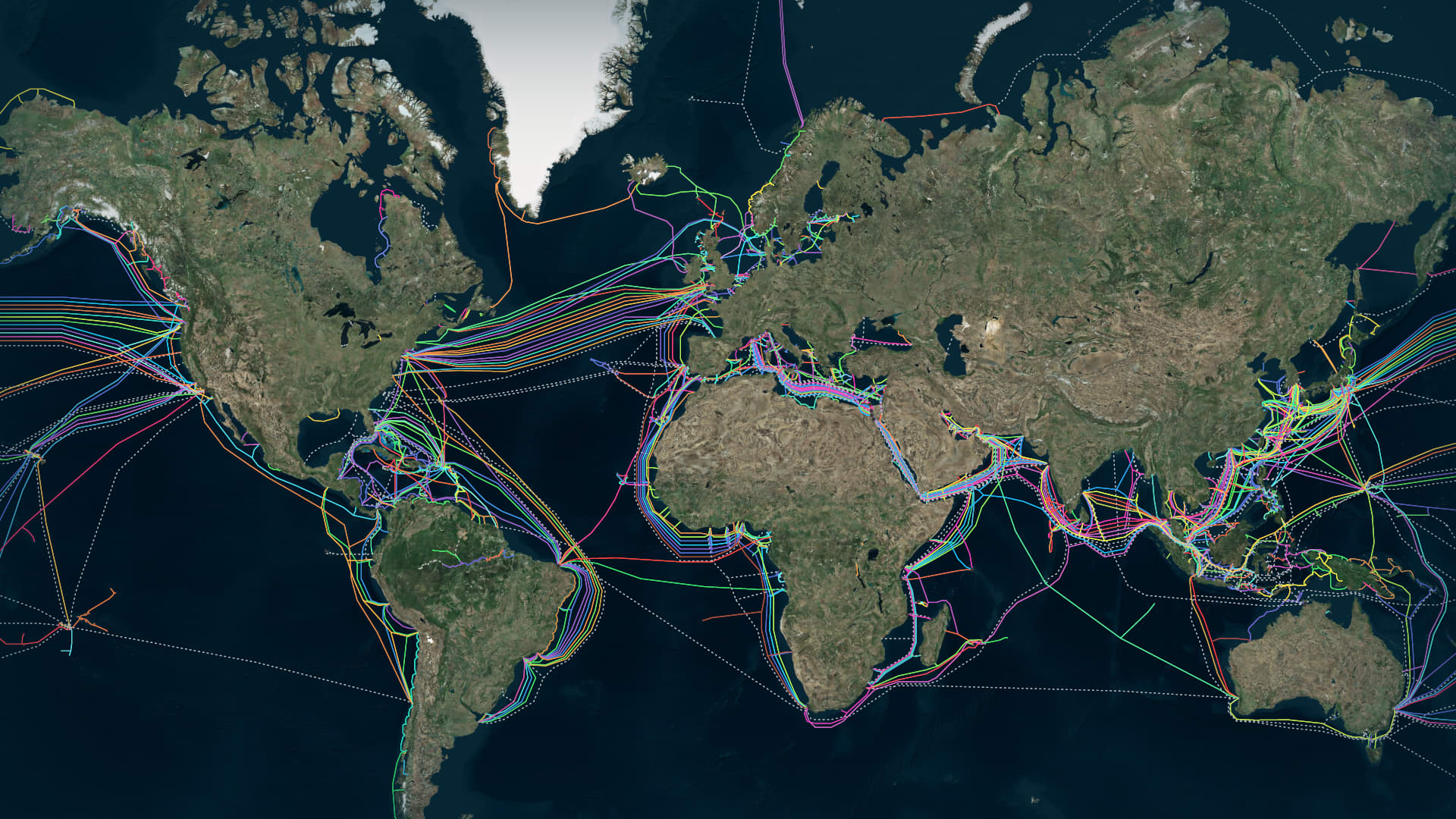

Subsea cables, a network spanning close to a million miles, carry over 95% of the world’s international data and voice traffic. These critical arteries of the digital world facilitate everything from government communications and financial transactions to email, video calls, and streaming services.
The history of subsea cables dates back to 1850, with the first installation across the English Channel between Dover and Calais for telegraph communications. The technology evolved from coaxial cables carrying telephone conversations to today’s fiber optics, the backbone of the modern internet.
“Approximately a decade ago, we witnessed the emergence of a significant new category: webscale players, including Meta, Google, and Amazon, which now account for an estimated 50% of the overall subsea cable market,” notes Paul Gabla, chief sales officer at Alcatel Submarine Networks, a leading manufacturer and installer of subsea cables.
The escalating demand for subsea cables is primarily driven by the exponential growth of data driven by artificial intelligence and the necessity to connect increasingly expansive networks of data centers worldwide.
Telecommunications data provider firm TeleGeography projects that investments in new subsea cable ventures will reach roughly $13 billion between 2025-2027, nearly double the investment levels between 2022 and 2024, as Big Tech scrambles to secure bandwidth.
A map of the world’s undersea communication cables.
CNBC | Jason Reginato
Big Tech, Big Cables: An Arms Race for Bandwidth
“AI is notably increasing our need for subsea infrastructure,” explains Alex Aime, vice president of network investments at Meta. “While AI often conjures images of data centers, computing power, and data storage, the reality is that without seamless connectivity between those data centers, they risk becoming extremely expensive yet underutilized warehouses.”
Meta’s Project Waterworth, a 50,000 km cable connecting five continents, is poised to become the world’s longest subsea cable project. This ambitious, multi-billion-dollar venture is fully owned by Meta and highlights the company’s commitment to controlling its connectivity destiny.
Amazon has also entered the arena with its first wholly-owned subsea cable project, Fastnet. This cable will connect Maryland to County Cork, Ireland, boasting a capacity exceeding 320 terabits per second, the equivalent of streaming 12.5 million HD movies concurrently.
“Subsea is truly essential for AWS and for all international connectivity across oceans,” asserts Matt Rehder, Amazon Web Services vice president of core networking. “Satellite connectivity, while viable, presents challenges with higher latency, elevated costs, and insufficient capacity to meet the ever-increasing demands of our customers and the internet as a whole.”
A ship belonging to Alcatel Submarine Networks deploys a plow to install subsea telecommunications cables.
Alcatel Submarine Networks
Google maintains a significant presence in the sector, having invested in over 30 subsea cables. Its latest project, Sol, will link the U.S., Bermuda, the Azores, and Spain.
Microsoft has also strategically invested in this critical infrastructure.
“The submarine cable industry has experienced considerable expansion over the past two decades, propelled by an insatiable global demand for data,” states Matthew Mooney, director of global issues at cybersecurity firm Recorded Future.
Cable Cuts: Vulnerabilities and Security Concerns
Disruptions caused by cable damage have the potential to result in considerable service outages, particularly in regions reliant on a limited number of internet connections.
“Severing a cable can effectively disconnect entire countries from internet access, disrupting financial transactions, banking, e-commerce, and essential communications,” cautions Erin Murphy, a senior fellow at the Center for Strategic and International Studies, a non-profit national security research institution.
Tonga, for example, experienced this when an underwater volcanic eruption in 2022 severed its only subsea cable, isolating the island nation from the global network.
In September 2025, damage to subsea cables in the Red Sea caused disruptions to Microsoft’s Azure cloud service. While Microsoft was able to reroute traffic, users in Asia and the Middle East experienced increased latency and performance degradation.
While most subsea cable damage stems from accidental causes, such as fishing activity or ships’ anchors, there is rising concern about potential acts of sabotage.
A subsea cable being manufactured at Alcatel Submarine Networks factory in Calais, France.
CNBC
“Given the high volume of vessels in international waters, including commercial and fishing vessels, the likelihood of accidents is significant,” notes Murphy. “However, malicious actors recognize this vulnerability. The deployment of so-called Russian ghost fleets or Chinese fishing vessels could provide cover for cable cutting incidents that could be dismissed as accidental. Distinguishing intentional sabotage from unintentional damage is a complex challenge.”
Recorded Future has observed an increase in suspected sabotage incidents. “We have seen a significant uptick in what we would consider intentional damages,” says Mooney. “Particularly in 2024 and 2025, we noted an elevated number of incidents in the Baltic Sea and around Taiwan. It remains difficult to definitively prove intentionality. However, the patterns observed in these events suggest that accidental causes may not be the only explanation.”
Mooney notes that the rise in suspected sabotage has coincided with heightened geopolitical tensions between Russia and Ukraine, as well as China and Taiwan. The strategic importance of these cables as critical economic and military infrastructure makes them attractive targets in hybrid warfare scenarios.
Despite the lack of conclusive evidence, governments are increasingly prioritizing the security of these essential assets.
In January 2025, NATO launched “Baltic Sentry” following several cable cutting incidents in the Baltic Sea. The operation employs drones, aircraft, and subsea and surface vessels to safeguard the region’s subsea infrastructure.
“We have not observed any instances of cable severing in the Baltic Sea since the implementation of Baltic Sentry in late January 2025,” confirms Mooney.
A picture taken on February 4, 2025 shows a Helicopter 15 (HKP15) (L) on the flight deck of patrol ship HMS Carlskrona (P04) on open water near Karlskrona, Sweden, as part of the NATO Baltic Sea patrol mission, the Baltic Sentry, aimed to secure critical underwater infrastructure. The patrol ship HMS Carlskrona (P04) set off from the naval port in Karlskrona on February 4, 2025 to become part of NATO’s Baltic Sentry operation as one of several Swedish ships that are part of Standing NATO Maritime Group One (SNMG1). This is the first time the ship has hoisted the NATO flag on board. The purpose of NATO’s Baltic Sentry operation is to demonstrate presence and secure critical underwater infrastructure. (Photo by Johan NILSSON / TT NEWS AGENCY / AFP) / Sweden OUT (Photo by JOHAN NILSSON/TT NEWS AGENCY/AFP via Getty Images)
Johan Nilsson | Afp | Getty Images
U.S.-China Tensions and Tech Supply Chains
In the United States, the Federal Communications Commission (FCC), responsible for granting licenses for subsea cables connecting to the U.S., has implemented stricter regulations on foreign firms engaged in building this infrastructure, citing security concerns.
“We have been particularly focused on threats posed by the Chinese Communist Party and Russia,” explains FCC Chair Brendan Carr. “We are actively taking measures to impede or effectively prohibit the establishment of direct undersea cable connections from the U.S. to nations considered foreign adversaries.”
Carr also emphasized the FCC’s commitment to ensuring the integrity of the hardware itself, barring Huawei, ZTE, and other potentially compromised “spy gear” from being utilized in subsea cable deployments.
In July, three House Republicans sent a letter to the CEOs of Meta, Amazon, Google, and Microsoft inquiring about the companies’ potential utilization of PRC-affiliated cable maintenance providers.
In response, Meta’s Aime clarified: “We do not collaborate with any Chinese providers of cable systems on the systems we’ve publicly disclosed, and we are in full compliance with U.S. policy regulations concerning ecosystem partners and supply chains.”
Amazon echoed Meta’s sentiment, affirming that it does not engage with Chinese companies in these projects.
Microsoft and Google did not respond to requests for comment.
“`
Original article, Author: Tobias. If you wish to reprint this article, please indicate the source:https://aicnbc.com/12521.html
