
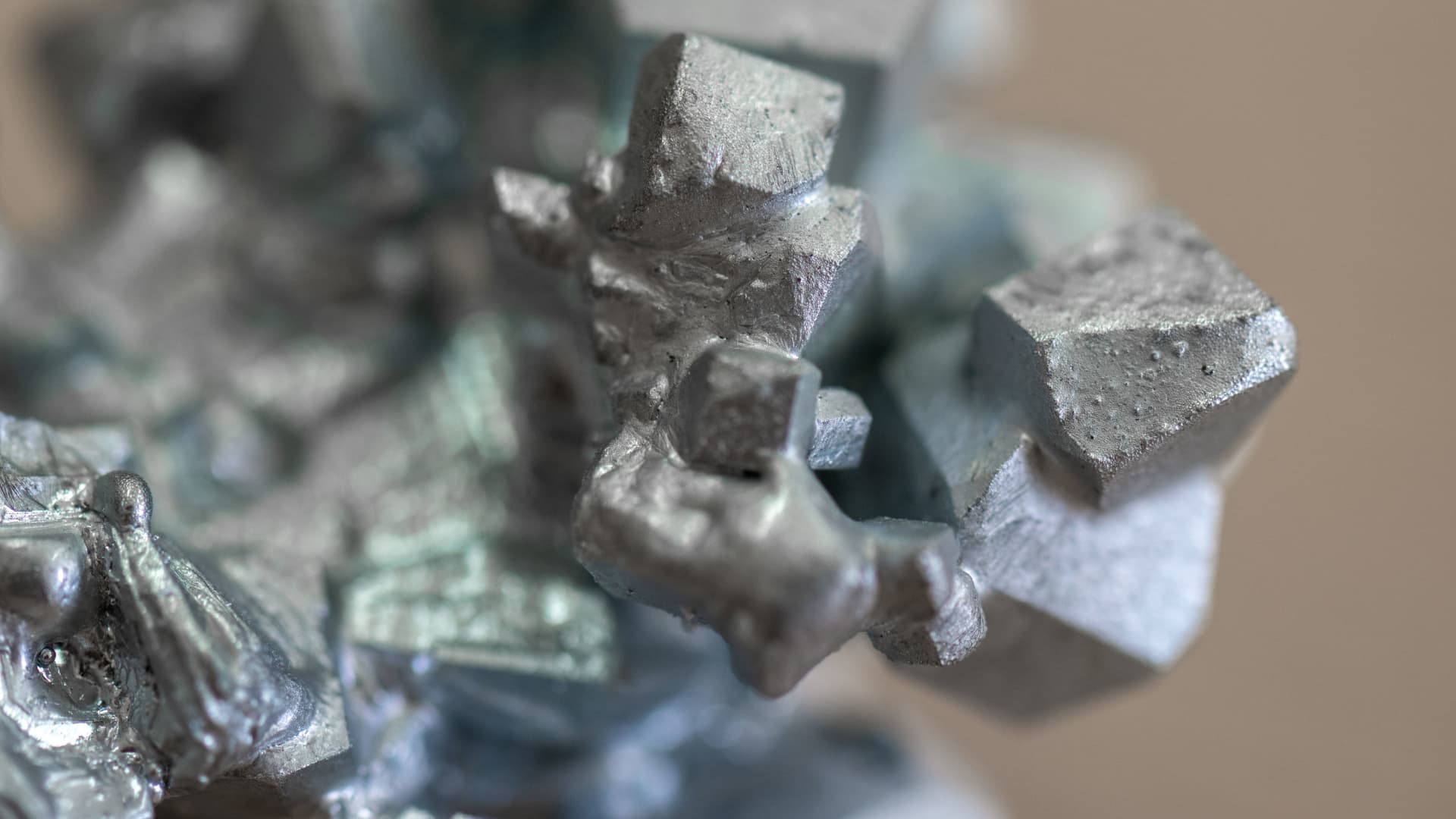

Crystals of gallium are seen in a laboratory at Freiberg University of Mining and Technology in Saxony, Germany on 13 September 2023.
Picture Alliance | Picture Alliance | Getty Images
In a move signaling a potential thaw in trade relations, China has eased export restrictions on a range of critical minerals and rare earth elements vital to U.S. technology and defense sectors. This decision is being viewed as a tangible outcome of recent high-level discussions between Washington and Beijing, suggesting a commitment to de-escalation amid ongoing trade tensions.
According to a statement released Friday by China’s Ministry of Commerce, the government will temporarily suspend certain export controls on key materials used in military hardware, semiconductor manufacturing, and other advanced technology industries. This suspension is slated to last for one year.
The relaxed restrictions, initially implemented on October 9th, include limitations on the export of specific rare earth elements, crucial lithium battery components, and associated processing technologies. The timing of this policy shift closely follows talks between U.S. President Donald Trump and Chinese President Xi Jinping in Busan, South Korea, on October 30th, suggesting a direct link between diplomatic engagement and trade policy adjustments.
Notably, Beijing has also reversed previously imposed retaliatory measures on exports of gallium, germanium, antimony, and various “super-hard” materials like synthetic diamonds and boron nitrides. These curbs, introduced in December 2024, were widely interpreted as a direct response to Washington’s tightened semiconductor export restrictions targeting China’s access to advanced chip technology.
China classifies these materials as “dual-use items,” underscoring their potential applications in both civilian and military domains. This classification highlights the strategic significance of these resources and the complex considerations surrounding their export. Beyond their military relevance, these critical minerals play a pivotal role in the semiconductor industry and other high-tech sectors, which are at the epicenter of U.S.-China trade disputes. The availability and control of these materials give China significant leverage in the global technology supply chain.
The suspension also encompasses the stringent end-user and end-use verification checks for exports of dual-use graphite to the U.S., which were introduced in December 2024 in conjunction with the broader export ban. By streamlining the export process, China is seemingly aiming to foster a more predictable and stable trading environment.
China’s dominance in the global production of most critical minerals and rare earth elements allows it to wield its export policies as a powerful tool in trade negotiations. This strategic advantage has been evident in past disputes, where China has demonstrated its willingness to use its control over these resources to exert pressure on trading partners.
As part of the most recent U.S.-China trade agreement, the U.S. has reportedly agreed to several concessions. These include a reduction of tariffs on Chinese imports by 10 percentage points and a suspension of Trump’s elevated “reciprocal tariffs” on Chinese imports until November 10, 2026. These concessions signal a reciprocal willingness from the U.S. to de-escalate trade tensions and foster a more balanced trade relationship.
Furthermore, the U.S. will postpone a rule announced on September 29th that would have blacklisted majority-owned subsidiaries of Chinese companies on its entity list, removing a significant point of contention that threatened further disruption to bilateral trade flows.
Analysts suggest that China’s recent actions are motivated by a desire to stabilize its economic outlook and maintain access to key technologies and markets. By easing export controls and offering concessions, China may be aiming to project an image of reliability and cooperation in the global trading system.
Original article, Author: Tobias. If you wish to reprint this article, please indicate the source:https://aicnbc.com/12573.html
