
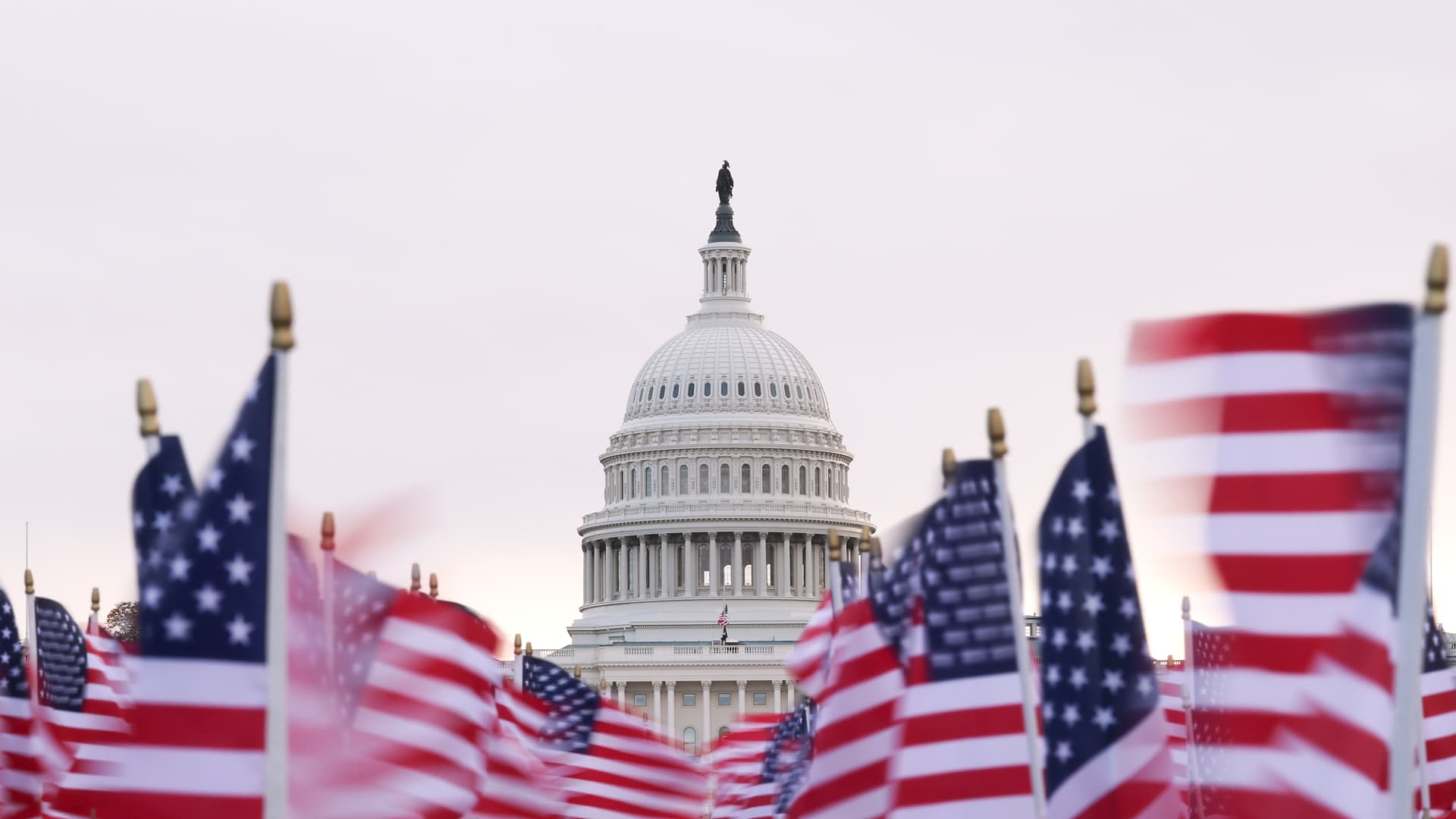

The U.S. Capitol is shown the morning after the Senate passed legislation to reopen the federal government on Nov. 11, 2025 on Capitol Hill in Washington, DC.
Win McNamee | Getty Images
A highly anticipated digital asset market structure bill is gaining momentum in the U.S. Senate, with the release of a draft from the Senate Agriculture Committee. This development is poised to facilitate broader institutional and retail adoption of cryptocurrencies, signaling a potential shift in the regulatory landscape.
Spearheaded by Agriculture Committee Chair John Boozman (R-Ark.) and Senator Cory Booker (D-N.J.), the bipartisan discussion draft offers a blueprint for establishing robust regulatory frameworks for the crypto industry. It outlines guidelines for institutions seeking to engage with digital assets, spanning from established cryptocurrencies like Bitcoin and Ether to tokenized financial instruments. The proposed framework aims to strike a balance between fostering innovation and safeguarding investors, a critical element for sustainable growth in the digital asset space.
“This represents a significant roadmap for institutional integration of digital assets,” notes a leading industry analyst. “It essentially provides a compliance checklist, detailing the necessary requirements for institutions to confidently and compliantly engage with cryptocurrencies.”
Here are five crucial aspects highlighted in the discussion draft:
1. Granting Favorable Regulatory Status to Select Cryptocurrencies
The draft designates certain high-market-capitalization digital assets, such as Bitcoin and Ether, as “digital commodities,” thereby placing them under the jurisdiction of the Commodity Futures Trading Commission (CFTC). This distinction is perceived as crucial for mainstream adoption.
This classification addresses a major obstacle for institutional fiduciaries contemplating digital asset investments. As one analyst from Bitwise, a crypto-focused asset manager, points out, “This gives compliance and risk departments a definitive federal statute to refer to. It reshapes the internal risk assessment process, providing the legal clarity necessary to allocate assets strategically.”
Furthermore, this regulatory clarity could result in a “bifurcated market,” marked by regulated and unregulated tokens. The former category is likely to witness a surge in institutional capital, increased liquidity, and a thriving derivatives ecosystem. This division could potentially create a two-tiered market with vastly different risk profiles and investor participation.
2. Mandating Fund Segregation and Conflict-of-Interest Management for Crypto Firms
The draft proposes that crypto companies “establish governance, personnel, and financial resource separation among affiliated entities that perform distinct regulated functions.” This provision aims to prevent potential conflicts of interest and protect customer assets.
According to analysts, this clause challenges the prevalent “all-in-one” business model adopted by many crypto exchanges, where exchange, brokerage, custody, and proprietary trading functionalities are consolidated within a single entity.
Consequently, digital asset firms may be required to segregate their business operations, mirroring the structure of traditional financial institutions. This restructuring could serve as a cornerstone for fostering institutional trust and encouraging wider participation.
3. Amplifying the CFTC’s Regulatory Authority Over Digital Assets
The draft empowers the CFTC with greater authority, enabling it to collaborate with the Securities and Exchange Commission (SEC) in formulating joint regulations concerning crypto-related matters. This aims to create a unified regulatory front.
“There’s a significant delegation of power to the CFTC to regulate the industry,” some analysts have stated.
This shift occurs after years of the SEC taking the lead in digital asset regulation, surpassing the CFTC in asserting its authority. The division of responsibilities between the SEC and CFTC will be a key factor in shaping the future regulatory landscape for cryptocurrencies in the U.S.
4. Authorizing the CFTC to Collect Fees
The draft proposes a fee structure, requiring regulated entities to contribute financially to the CFTC. These fees would be allocated to registering digital commodity exchanges, brokers, and dealers, while also supporting oversight activities and educational initiatives. This would provide the CFTC with a dedicated funding stream for regulating the digital asset market.
5. Establishing Listing Standards for Tokens
The draft stipulates that crypto exchanges should only facilitate trading of digital commodities that are “not readily susceptible to manipulation.” This aims to enhance market integrity and investor confidence.
This provision is designed to curtail “rug pulls” and other fraudulent schemes that remain prevalent in certain segments of the crypto industry, ultimately establishing standards and bolstering market confidence. By implementing stringent listing standards, the aim is to minimize the risks of illegitimate projects defrauding investors.
Looking Ahead
While the Senate Agriculture Committee’s discussion draft remains a preliminary version, it offers valuable insights into the direction of efforts to formulate crypto-friendly regulations in the U.S.
“While it’s not yet finalized, it offers a clear indication of the Congressional trajectory and the likely characteristics of the final rules,” observes one expert.
The committee is expected to solicit feedback on the draft over the coming weeks, potentially making it challenging to finalize this portion of the bill by year-end. The timeframe, however, avails an opportunity for lawmakers to provide more detailed guidance on outstanding issues, including anti-money laundering rules and regulations specific to decentralized finance (DeFi) platforms.
Industry stakeholders are planning to collaborate with lawmakers to clarify these outstanding details.
“This draft from Chairman Boozman and Senator Booker underscores the bipartisan nature of the crypto issue,” remarked a leading executive. “It’s crucial that legislation distinguishes between centralized intermediaries and decentralized systems, and we look forward to working with the Committee to get it right.”
The discussion draft is just one building block in a larger legislative endeavor to reform crypto industry regulations. Ultimately, this draft will be integrated with the Senate Banking Committee’s proposal on digital asset market structure, aiming to produce a comprehensive, unified bill. The convergence of these efforts is anticipated to streamline the regulatory framework for digital assets.
Despite the ongoing legislative process, crypto firms are exploring alternative avenues to collaborate with regulators and advance their industry. The industry is showing resilience and adaptability in the face of regulatory uncertainty. Thoughtful legislation, once enacted, will be essential to securing the long-term success of the digital asset industry in the U.S., delivering greater value to both investors and consumers.
Original article, Author: Tobias. If you wish to reprint this article, please indicate the source:https://aicnbc.com/12683.html
