

Hewlett Packard Enterprise reported a soft fourth‑quarter revenue and server performance, yet it beat earnings expectations and reaffirmed its fiscal‑year outlook amid robust artificial‑intelligence demand.
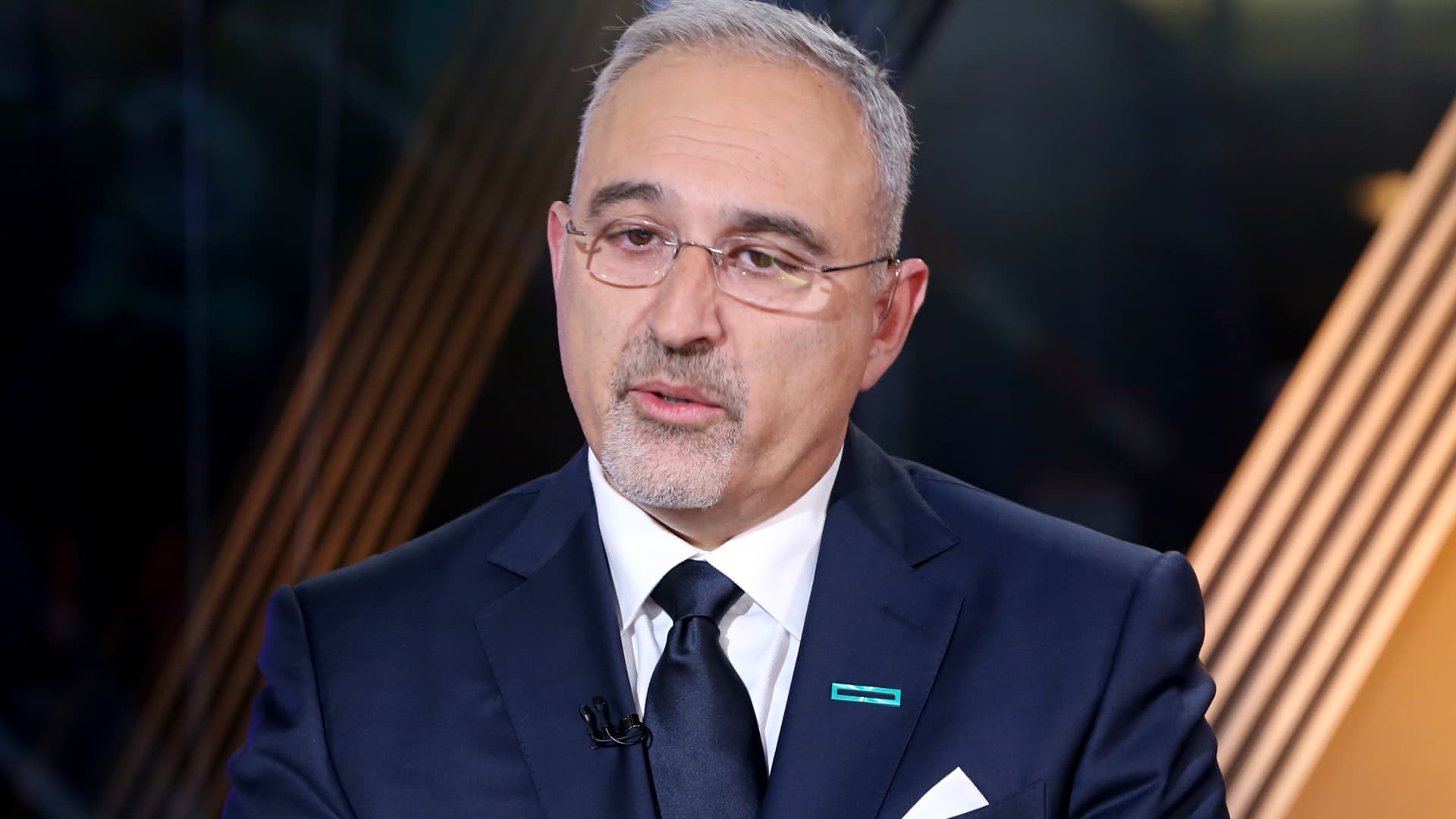
“I’m incredibly pleased with the results we posted in Q4 … despite being on the lower end of the revenue guidance, which was driven by the conversion of a few marquee AI deals, a couple impacted by the U.S. shutdown, and one in Europe tied to data‑center readiness,” CEO Antonio Neri said on CNBC’s Money Movers on Friday.
The company released its earnings after the market close on Thursday, posting revenue of $9.68 billion—up 14% year‑over‑year but below the $9.94 billion consensus forecast from analysts tracked by LSEG.
The revenue miss and a slip in the server segment initially knocked the stock down as much as 9%, though shares recovered on Friday.
Adjusted earnings came in at $0.62 per share, surpassing the $0.58 consensus estimate.
CFO Marie Myers explained that the earnings uplift reflected “amortization of intangible assets, acquisition‑related costs from the Juniper deal, stock‑based compensation, and expense reductions, partially offset by tax adjustments and other items.”
HPE reaffirmed its fiscal‑2026 revenue guidance of 17%‑22% growth but delivered a subdued forecast for the first quarter, targeting $9.0‑$9.4 billion—below the $9.87 billion projected by FactSet analysts.
Rising component costs, seasonal dynamics and the timing of AI‑server shipments were cited as the primary drivers of the weaker outlook.
Myers noted that the Q4 dip “aligns with historic seasonality” and highlighted ongoing cost pressures in DRAM and NAND flash memory. She added that the majority of these cost increases are expected to be passed through to customers.
AI system orders reached $1.9 billion in the quarter. However, Myers cautioned that AI demand will be “uneven,” with large sovereign customers placing orders that carry extended lead times, potentially deferring shipments into later quarters.
Neri said the bulk of AI‑related revenue conversion is expected to materialize in the second half of fiscal 2026.
Server revenue fell 5% to $4.46 billion, missing StreetAccount’s $4.58 billion estimate. Myers attributed the shortfall to the timing of AI service shipments and lower‑than‑expected government spending.
“Despite these headwinds, we were encouraged by robust order growth across both traditional and AI‑focused servers, with demand significantly outpacing revenue in this period,” she said.
Server revenue declined 10% versus the third quarter.
Networking revenue posted a brighter note at $2.81 billion, buoyed by the July integration of Juniper Networks. Neri told CNBC that the acquisition positions HPE as “a networking‑centric company.”
Net income for the quarter dropped to $146 million, or $0.11 per share, compared with $1.34 billion, or $0.99 per share, a year earlier.
Strategic Implications and Market Outlook
The fourth‑quarter results underscore the transitional phase HPE is navigating as it pivots toward AI‑optimized infrastructure. While revenue growth remains solid on a year‑over‑year basis, the lag in server sales highlights a broader industry challenge: aligning manufacturing capacity with the erratic timing of AI‑driven procurements.
Component shortages and price volatility, especially in memory subsystems, continue to squeeze margins across the data‑center market. HPE’s strategy of passing through these costs helps protect profitability, but it also raises the risk of price sensitivity among cost‑conscious enterprise buyers.
The Juniper acquisition adds a critical networking layer to HPE’s portfolio, enabling tighter integration of compute, storage, and networking—an architecture increasingly demanded by hyperscale operators and large‑scale cloud providers. Competitors such as Dell Technologies and IBM are also deepening their AI‑focused offerings, intensifying the battle for market share in high‑performance computing (HPC) and generative‑AI workloads.
Looking ahead, HPE’s ability to convert its pipeline of AI contracts into shipped revenue will be a key performance indicator. The company’s guidance for FY 2026 suggests confidence in sustained demand, but investors should monitor the cadence of government contracts and the pace of AI‑related capital expenditures, which remain susceptible to macroeconomic fluctuations.
In summary, while HPE’s Q4 earnings beat signals operational resilience, the mixed revenue signals and a cautious near‑term outlook reflect the broader uncertainties of a market still grappling with the scaling challenges of AI‑centric infrastructure.
HPE one‑day stock chart.
Original article, Author: Tobias. If you wish to reprint this article, please indicate the source:https://aicnbc.com/14120.html
