
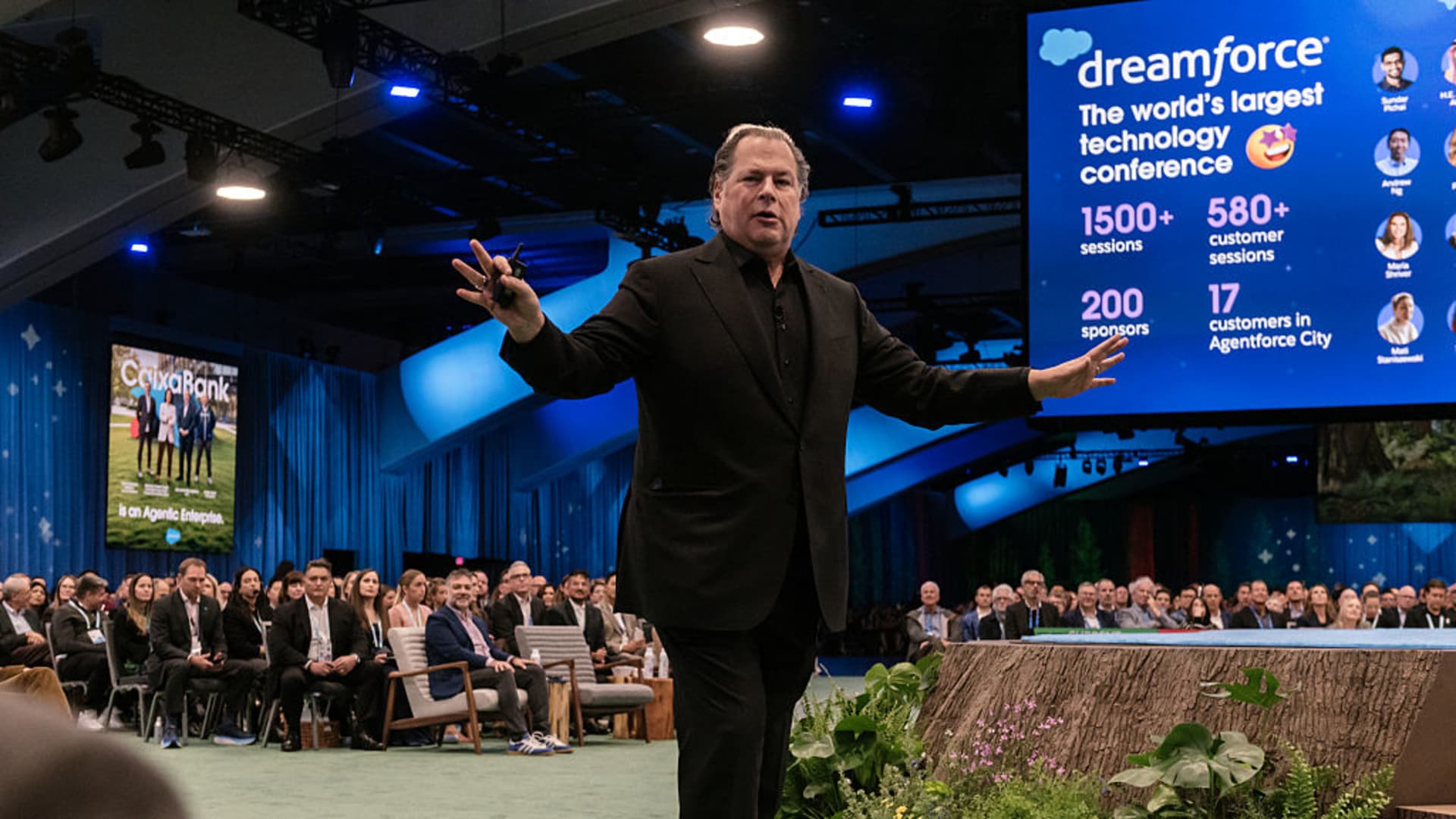

Marc Benioff, chief executive officer of Salesforce Inc., speaks during the 2025 Dreamforce conference in San Francisco, California, US, on Tuesday, Oct. 14, 2025.
Michael Short | Bloomberg | Getty Images
Salesforce shares surged as much as 5% in after-hours trading Wednesday following the unveiling of ambitious long-term financial targets at the company’s annual Dreamforce conference in San Francisco.
The cloud-based software giant now projects revenue exceeding $60 billion by 2030, surpassing the $58.37 billion consensus estimate from analysts surveyed by LSEG. This forecast aims to reassure investors amid lingering concerns about growth deceleration and the transformative potential of artificial intelligence in software development.
It’s important to note that this guidance excludes any impact from the pending acquisition of Informatica, a data management company. The $8 billion deal, set to close either in the fiscal fourth quarter of 2026 or the first quarter of fiscal year 2027, is poised to further bolster Salesforce’s capabilities in data integration and analytics.
“We have had some lower-stage growth for a while,” stated Robin Washington, Salesforce’s chief operating and financial officer, during an investor briefing at Dreamforce. “That is reaccelerating.” This statement signals renewed confidence within the company regarding its growth trajectory.
Salesforce is targeting an organic year-over-year revenue growth rate above 10% for the fiscal years 2026 through 2030. This marks a significant goal, considering the growth rate has remained below 10% since mid-2024. The company’s ability to achieve this target will be closely scrutinized by investors.
One of the major factors weighing on investor sentiment has been the emergence and advancement of AI-powered code generation tools. These tools, often touted as revolutionizing software development by automatically generating code from simple prompts, have raised concerns about their potential impact on established software providers. Microsoft CEO Satya Nadella revealed in April that AI is already contributing to up to 30% of new code at his company.
However, Salesforce CEO Marc Benioff dismissed the hype surrounding AI’s imminent takeover of software development. “There’s a certain amount of, let’s just say, nonsense that’s out there,” Benioff asserted on Wednesday. “Like, for example, that these products are writing all the software, and that is not what’s happening.” While acknowledging the potential of AI, Benioff emphasized the continued importance of human expertise and nuanced understanding in software creation.
Despite the positive guidance, Salesforce’s stock performance lags behind the broader market. As of Wednesday’s close, the stock was down 29% year-to-date, while the Nasdaq composite index has risen by 17% during the same period. This disparity highlights the market’s uncertainty regarding Salesforce’s future growth prospects.
To reignite revenue growth, Salesforce is placing significant emphasis on its Agentforce software suite, designed to automate customer service and other crucial business processes. Washington, who also holds a seat on Salesforce’s board of directors, highlighted Agentforce as a key driver of future expansion. Launched last year, Agentforce enables brands to provide chat-based customer service agents powered by large language models that seamlessly integrate with internal data.
Despite the potential of Agentforce, RBC Capital Markets analysts noted in a recent client note that “investors continue to ask why Agentforce adoption has been slower than anticipated.” This highlights a key challenge for Salesforce: accelerating the adoption of its AI-powered solutions to meet market expectations.
In response to these concerns, Salesforce executives are actively working on product enhancements and strategic partnerships to attract new business opportunities. The company unveiled Agentforce Voice on Monday, allowing clients to integrate AI-powered agents into their customer service call centers. Furthermore, on Tuesday, Salesforce announced expanded collaborations with leading AI model developers Anthropic and OpenAI, further integrating their advanced models into the Agentforce platform. This strategic move aims to enrich Agentforce’s capabilities and provide customers with cutting-edge AI solutions.
At Dreamforce, Salesforce showcased Agentforce implementations across a range of prominent companies, including FedEx, Pandora, PepsiCo, and Williams Sonoma. These case studies serve as testimonials for Agentforce’s real-world effectiveness and potential to drive tangible business outcomes. However, the key will be demonstrably scaling these successes across a broader customer base.
Original article, Author: Tobias. If you wish to reprint this article, please indicate the source:https://aicnbc.com/11001.html
