
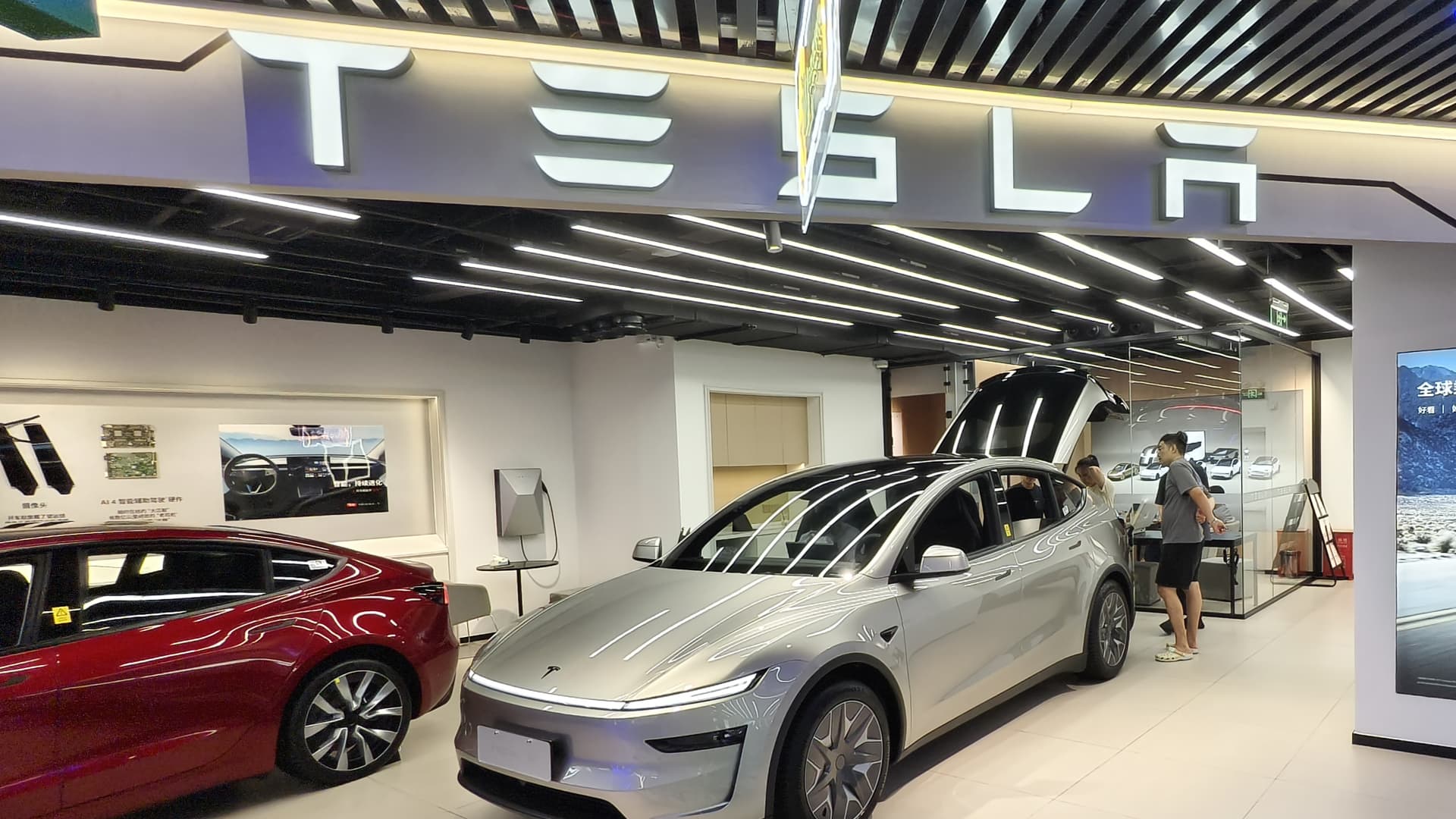

After years of regulatory hurdles and anticipation, Tesla announced Thursday that its Full Self-Driving (FSD) capabilities are now officially available for its electric vehicles sold in China. This move comes as domestic Chinese EV brands have steadily advanced their own proprietary autonomous driving technologies, intensifying the competitive landscape.
The announcement, made on X (formerly Twitter), a platform also owned by Tesla CEO Elon Musk, designates China as one of 10 key markets where the company’s FSD (Supervised) system is rolling out. While specific operational details remain scarce, this marks the first confirmation of FSD’s availability in the crucial Chinese market, a significant development following a protracted period of ambiguity.
This strategic rollout coincides with a week after Musk’s participation in a high-profile summit in Beijing, alongside a delegation of U.S. business executives and U.S. President Donald Trump, engaging with Chinese leader Xi Jinping. The timing suggests a potential alignment with broader diplomatic and economic initiatives.
Prior to Thursday’s announcement, the deployment of Tesla’s FSD technology in China had been a subject of considerable uncertainty. Unlike consumers in the United States, Tesla customers in China had previously been limited to the company’s Autopilot and Enhanced Autopilot systems – foundational precursors to FSD. While some select users had access to limited iterations, the widespread availability was contingent on securing regulatory approvals, a process that repeatedly faced delays.
According to Tesla’s China website, the “intelligent assisted driving” feature is offered on its Model 3 sedan with a one-time fee of 64,000 Chinese yuan, approximately $9,409. This pricing positions FSD as a premium offering, underscoring the advanced nature of the technology.
Musk had publicly outlined plans to introduce the FSD system, initially unveiled in the U.S. in 2020, to the Chinese market as early as 2024. However, these ambitious timelines did not materialize as projected. In July 2024, during the company’s second-quarter earnings call, Musk expressed optimism about securing regulatory approval from Chinese authorities by the end of that year. This timeline was subsequently pushed back to September 2024, with Musk citing the technology as still “pending regulatory approval.” As recently as April of this year, Tesla’s CFO, Vaibhav Taneja, reiterated in the first-quarter earnings call that the company was still awaiting the necessary clearances for the FSD system.
Speculation surrounding the approval of Tesla’s autonomous driving technology in China had intensified in recent days. Reports from Bloomberg on Wednesday indicated that Tesla had initiated a significant hiring drive in the country for roles directly related to autonomous driving technology, including autopilot test engineers. This proactive recruitment suggests a bolstered confidence in imminent regulatory green lights.
While Tesla navigated the approval process, Chinese competitors have not stood still. Companies such as Xiaomi and Xpeng have aggressively expanded their proprietary self-driving technologies, establishing a strong foothold in the domestic market. Furthermore, Chinese robotaxi pioneers like Pony.ai and Baidu’s Apollo Go have made substantial strides in developing and deploying their autonomous driving solutions, even expanding their operations into international markets.
The competitive landscape is further highlighted by Tesla’s market position. In April, Tesla ranked fourth in electric vehicle sales in China, trailing behind BYD and major automotive conglomerates Geely and Chery, according to monthly wholesale figures from the China Passenger Car Association. The successful deployment of FSD could provide Tesla with a much-needed competitive edge in this rapidly evolving market.
A representative for Tesla China declined to comment on the FSD rollout. Attempts to reach the Chinese embassy in Singapore for comment were not immediately successful.
Original article, Author: Tobias. If you wish to reprint this article, please indicate the source:https://aicnbc.com/21953.html
